
Transforming Schoolyards into Climate Solutions
The sold-out From Runoff to Resilience Symposium highlighted how living schoolyards can transform paved campuses into greener, healthier spaces that benefit students and strengthen climate resilience.
July 13, 2026
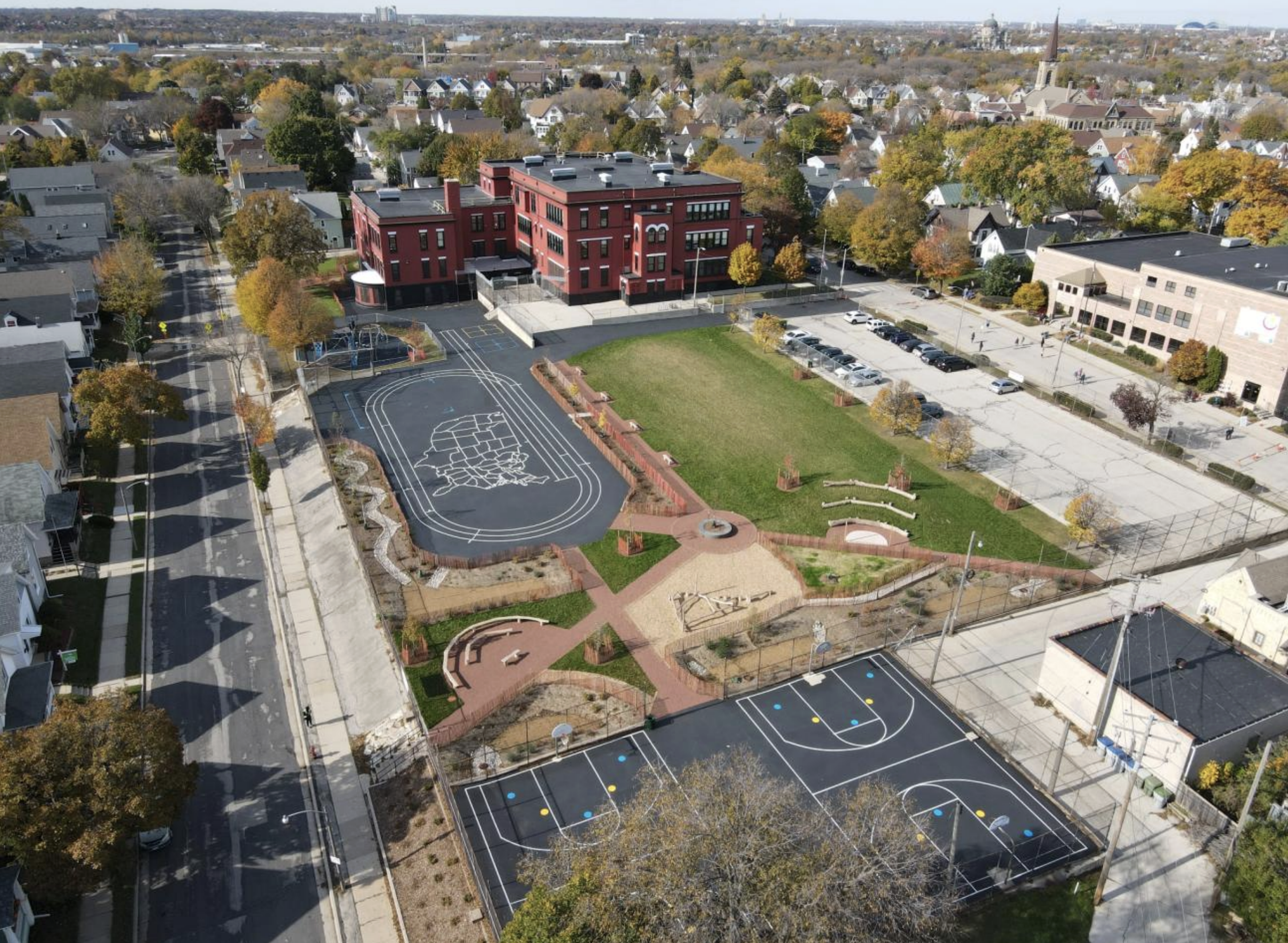
“After” photo of Milwaukee public school campus. Photo credit: Reflo.
IMPLEMENTING LIVING SCHOOLYARDS in Los Angeles County has proven difficult. While we often focus on the difficulties of transitioning to living schoolyards, challenges still exist once the work is completed as well. Living schoolyard projects represent a long-term solution that school districts have developed to increase climate resilience while providing a nourishing environment that benefits students across the region.
In November, Council for Watershed Health, Heal the Bay, Los Angeles Waterkeeper, and Randolph Consulting Group began these efforts by presenting on the nexus of living schoolyards and stormwater harvesting on school campuses for the California Green Schools and Higher Education conference.
We continued these efforts this past May, by hosting the From Runoff to Resilience Symposium to discuss stormwater harvesting and living schoolyard projects across the region. The event had high interest and sold out nearly two months in advance. The audience included teachers, school district representatives, facilities staff, agencies, funders, watershed coordinators, and community members.
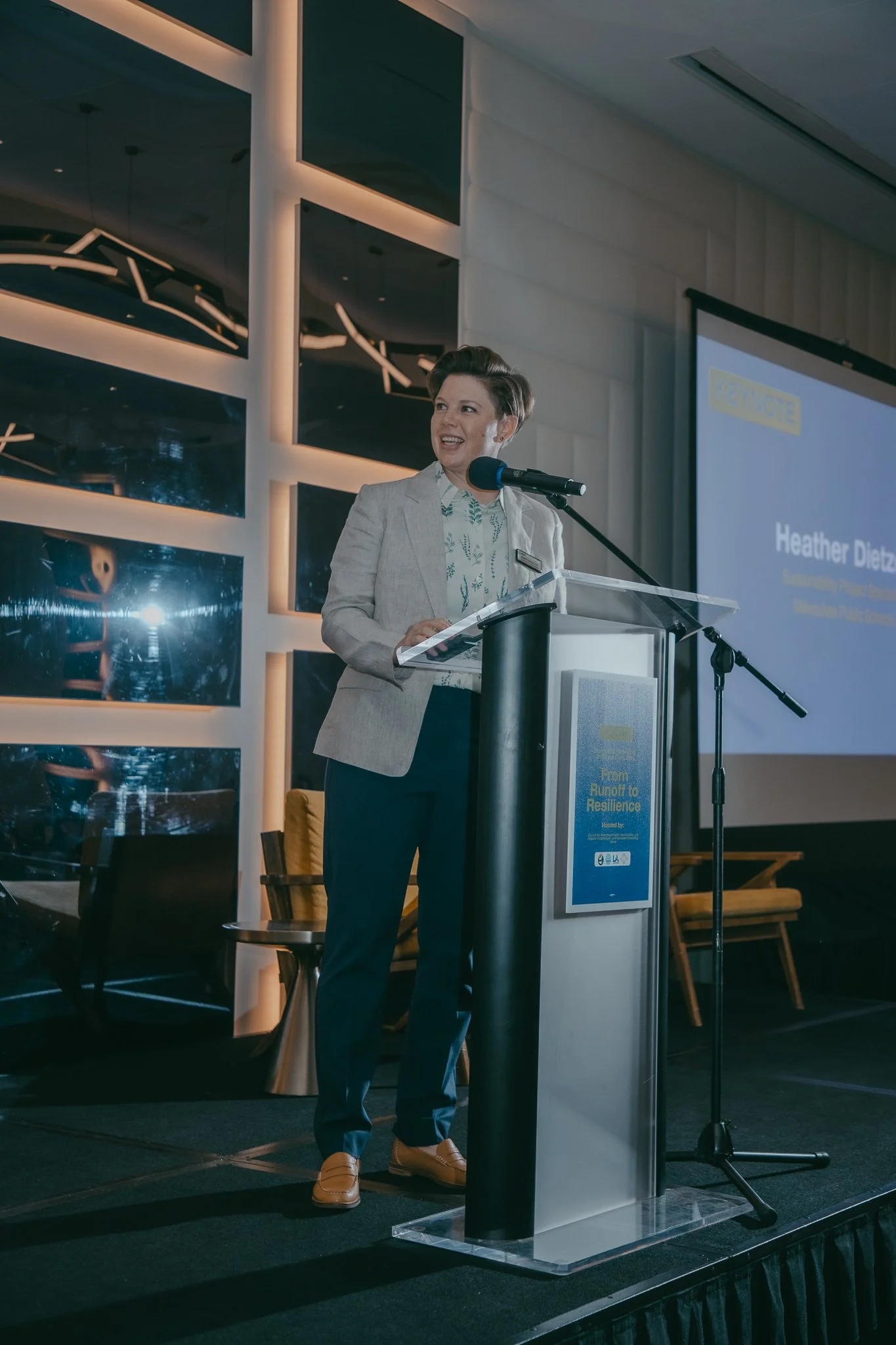
Heather Dietzel of Milwaukee Public Schools shares how transforming asphalt schoolyards into nature-based spaces can manage stormwater while supporting student learning and well-being.
Heather Dietzel, Sustainability Project Specialist from the Milwaukee Public Schools (MPS), opened the symposium on an optimistic note by showing how MPS’s work transforming barren, asphalt schoolyards into nature-based spaces that manage on-site stormwater has benefited both Milwaukee’s overwhelmed stormwater system and improved student learning and wellbeing on-campus.
Despite their vastly different climates and sizes, Dietzel’s keynote revealed unique parallels between MPS and LA County’s 80 school districts. While school districts in LA County collectively served over 1.24 million students in the 2025-2026 school year, both school districts are predominantly composed of highly underserved populations. In fact, 82% of MPS students and 72% of students attending public schools in LA County are considered socioeconomically disadvantaged. Both MPS and LA County’s school districts also face similar challenges, including declining student enrollment, budget shortfalls, and managing school campuses that are largely covered in asphalt. Currently, MPS includes over 500 acres of impervious surfaces and LA County’s 3,000+ school campuses contain approximately 15,240 acres of pavement. Despite the difference in scales, there are several lessons LA County’s school districts can learn from MPS and how they are transforming their school campuses into vibrant living schoolyards that harvest stormwater and connect students to their local watersheds.
Strategic Partnerships are key. Without non-profit partner ReFlo and the Milwaukee Metropolitan Sewerage District, Dietzel shared that MPS would not have been able to transform 37 schoolyards over the past 7 years, resulting in over 1.04 million square feet (SF) of asphalt removal, the planting of over 4,000 trees and restoration of 327,000 SF of native habitat, and management of 4.3 million gallons of stormwater per rain event!
Our case studies panel featuring Sonali Abraham, Claire Robinson, and Heather Dietzel, moderated by Eileen Alduenda built on Heather Dietzel’s keynote showcasing the potential stormwater capture of LA County schools, successful stormwater capture projects in LA County, and how MPS goes from a concept to a finished living schoolyard project. Schools offer a massive opportunity for greening and stormwater capture in LA County- Pacific Institute’s research indicates nearly 3.15 billion gallons of stormwater runoff is generated on LA County schools every year. Learning from successful LA projects completed by Amigos de los Rios and MPS (as well as organizations represented throughout the program) is essential to making implementing living schoolyards easier and more widespread across our region.
After the inspiring keynote and informative case studies were presented, attendees had the choice of attending two of three breakout sessions. These sessions included “From Project Concept to Implementation: From a Landscape Architect and Project Management Perspective” with Meagan Yellott, Robin Mark, Claire Latané, and Tori Kjer; “Immediate and Long-term O&M” with Tashanda Jones, Monica Campagna, Alyson Mello, and Juan Alvarez; and lastly, “Offsite Stormwater & Liability Roadblocks” with Alejandro Fabian, Anthony Pham, Christina Davila, Barbara Romero, and Sonya Williams. Key learning from the breakout sessions included:
Living schoolyard projects require responsible planning, early coordination and identification of risk, and clear solutions. Projects should not only focus on solving environmental concerns but be a multifaceted solution that targets school requirements and prioritizes student needs.
Systems change and treating greening schoolyards as a long game is necessary in order to create the wide scale impact we aim to achieve.
Learning how to turn “no” around by understanding the concerns from school sites and district administrators, being flexible, and tackling concerns head-on is essential. So is learning when to push back.
A living schoolyard should not be a project on top of everything else a school is worried about, but rather a solution that will help them achieve their established goals (whether that is social-emotional issues, increasing attendance, providing workforce development, etc.).
Local champions have a huge impact on whether projects get built. Make sure to find someone who can champion your project, but you still need a village. Build your network and your capacity with partnerships - community relationships improve safety and stewardship.
Funding is key to getting these projects implemented, especially having multiple sources as funding opportunities can drive adoption. The more funding we can bring and keep in this space, the better.


Before and After Photos of Milwaukee Public School Campus. Photo credit: Reflo.
The final session tackled the funding challenge that permeated much of the symposium. James Cortes, Aleigh Lewis, Salian Garcia, and Henry Herrera shared about funding sources available for project developers and schools to tap into to help fund living schoolyard projects in LA County. Upcoming funding opportunities shared by panelists and earlier in the program include Cal Fire’s Green Schoolyards Grant Program, Rivers and Mountains Conservancy (RMC), Baldwin Hills and Urban Watersheds Conservancy, and Measure W’s Safe Clean Water Program.
The symposium concluded with Dr. Marci Raney reminding everyone that green infrastructure can be more than just a way to harvest stormwater by showcasing how green spaces improve the lives of students including contributing to their sense of belonging, cognitive health, and academic performance.
Implementing living schoolyards is difficult, but it's not impossible. These opportunities require a learning curve from everyone- school districts and practitioners alike, but together, we can work towards making living schoolyards a reality for all students.
Here are some resources shared by our presenters in case you want to dig deeper:
Some resources shared by our speakers are below:
Resource List from Marci Raney including research, tools, and award/certification programs
Advancing Stormwater Capture for Greener Schools in Los Angeles report
Untapped Potential: Leveraging Schoolyards for Stormwater Management & Climate Resilience report
CalFire:
Urban and Community Forestry Grants | CAL FIRE (our website page)
Urban and Community Forestry (our hub site)
LAUSD:
Also available as a quick link (scroll down page to section titled quick links) from the LAUSD Facilities Website
O&M resources
This work is supported by Accelerate Resilience Los Angeles (ARLA), Water Foundation, and the Los Angeles County Flood Control District's Safe Clean Water Public Education and Community Engagement Grants Program.